
04 July 2025 Athens Exhibition Says the Revolution Could Begin on Your Plate | 04 June 2025 Artforum, "Diana Anselmo" | 16 April 2025 Frieze, "Must-See: The Tears of Karl Lagerfeld" | 16 April 2025 Süddeutsche Zeitung Magazin, "Mit welcher Haltung kommt man in der Kunstwelt am weitesten, Maurizio Cattelan?" | 09 April 2025 The Berliner, "Consider Listening: An exhibition urging calm amidst outrage" | 02 April 2025 Wallpaper, "Aboard Gio Ponti's colourful Arlecchino train in Milan, a conversation about design with Formafantasma" | 26 March 2025 Frieze, "Diego Marcon’s Films Conjure a Familiar, Grotesque World" | 19 March 2025 Arts Hub, "1500-degree molten steel installation, inspired by Caravaggio, to drip from the ceiling of Mona" | 15 May 2024 Frieze, "Silvia Rosi Gives Voice to Her Parents’ Migration Story" | 30 March 2024 The Korea Times, "Foreigners Everywhere: Artist duo who inspired this year's Venice Biennale lands in Seoul" | 07 February 2024 Artnet News, "Ceramics Are as Contemporary as a Smartphone: Chiara Camoni on Her Tactile Sculptures"
Salvatore Arancio
interviews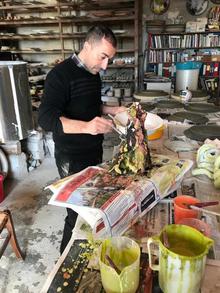
14 April 2026
Artists
Salvatore Arancio. A practice between Science and fiction, developed abroad
In 1994, Salvatore Arancio moved to England, where he studied at the London College of Printing and later at the Royal College of Art. In this context, he expanded his research by experimenting with techniques such as etching and video, in order to explore the meaning of images and their expressive possibilities. After several group exhibitions, in 2006 he received the New Contemporaries award and subsequently the New York Prize, which enabled him to undertake a period of research at Columbia University. A turning point came in 2011, during a residency at the Carlo Zauli Museum in Faenza, when he discovered ceramics—now central to his practice—used as a true pictorial medium in which color and form hold equal importance. Following his participation in the 57th Venice Biennale, numerous exhibitions and international collaborations have consolidated his recognition, establishing him as one of the most acclaimed figures in contemporary Italian art. We discussed this journey in the following interview.
Your practice draws on a wide range of references, from geology and mythology to the history of science. To what extent did this hybrid approach influence your decision to seek out an international context for your work?
My practice has always been driven by a kind of epistemological curiosity, an interest in how knowledge is constructed, classified and sometimes fictionalised. Drawing from geology, mythology and the history of science was never a strategic decision, it emerged as a natural convergence of interests. However, this hybrid approach found a more fertile ground when I moved from Italy to the UK. In particular, the legacy of Victorian culture, with its obsession for taxonomy, collecting and the institutionalisation of knowledge through museums, archives and scientific societies, became an important reference point for me.
The Victorian tendency to blur the boundaries between scientific inquiry and speculative imagination resonates strongly with my own approach. Moving to London, then, was not only about accessing a broader international platform, but also about situating my practice within a cultural and historical framework where interdisciplinary thinking and even ambiguity has deep roots and is more readily recognised and valued.
Moving to and working in a city like London has been a defining step in your career. What challenges did you face early on?
Moving to London was both necessary and intentional. There were certainly pragmatic reasons: a meritocratic society, selective but at the same time free access to education, stimulating institutions, visibility and a artistic network that simply didn’t exist in the same way in Italy at the time. But it was also about entering a context where ambiguity and experimentation were accepted and encouraged. London offered a kind of intellectual openness that resonated with my needs at the time. That said, the early challenges were significant, financial instability, the difficulty of establishing oneself in a highly competitive environment and the sense of dislocation that comes with leaving your cultural base, all of which continuously made me question myself.
Your ceramics, often characterized by highly glazed surfaces and vivid colors, evoke both natural formations and “alien” objects. How has the international context shaped the reception and evolution of this visual language?
It has deeply influenced both how my work is received and how it has evolved, but also how I initially approached ceramics as a medium. Although my technical engagement with ceramics developed through traditional workshops in Italy, my conceptual framework was already developed during my time in the UK. This meant that, from the very beginning, I wasn’t approaching ceramics through a purely artisanal or functional lens. Instead, the medium became a vehicle for ideas that were already shaped by a perspective formed within an international and interdisciplinary perspective. The glazed, almost synthetic surfaces and vivid colours were never intended to reference tradition directly, but rather to construct artworks that exist in an ambiguous space, somewhere between the organic and the artificial, between natural formations and “alien” presences. This created an inherent hybridity in the work: on one hand, a strong grounding in the technical discipline and material knowledge of Italian ceramic traditions; on the other, a conceptual approach informed by a broader, international discourse.
What are the key differences between the Italian art system and the international one in terms of openness to experimental practices like yours?
I would say that historically Italy has been more conservative, more tied to tradition and medium specific practices. There is, or at least there was, less infrastructure for supporting experimental, cross disciplinary work. This is also connected to the fact that much of the discourse has remained strongly grounded in a few dominant postwar movements like Arte Povera for example, as well as the legacy of a few influential curators, critics and academic figures whose writings and teaching have had a long lasting impact on how art is understood and evaluated within institutions and universities.
While these histories are of course fundamental, they can sometimes produce a certain rigidity. Internationally, especially in cities like London, Berlin or New York, it tends to be a stronger and more diversified ecosystem of curators, institutions and galleries that actively seek out and support practices that challenge conventional boundaries and that are perhaps less tied to a single historical narrative.
Your work has gained significant visibility abroad. Has this international recognition translated into greater attention in Italy?
When I moved to the UK, it wasn’t so common for Italian artists to move or study outside of Italy, apart from certain contexts like Berlin, which was already quite established as a destination or perhaps Paris and in some sporadic cases New York. London, in particular, felt less typical and a tougher environment, but on the other hand that distance from the Italian system, allowed me to develop my work with a certain freedom and without immediate influences. Starting internationally gave me visibility and positioned my practice within a broader discourse from the outset, which was crucial. It created opportunities and connections that would have been much harder to access had I remained in Italy at that stage. As for whether this recognition has translated back into Italy, I am less certain. The relationship feels more complex and less immediate, there isn’t always a clear correspondence between recognition abroad and visibility within the Italian context.
Participation in the Venice Biennale is often seen as a pivotal moment in an artist’s career. What kind of impact did this experience have on your trajectory and on the visibility of your work?
Participating in the Venice Biennale was undoubtedly a pivotal moment as well as being one of the most stressful time in my life! It obviously amplified the visibility of my work and placed it within a global conversation at a very high level. It also created a kind of acceleration, suddenly there was more attention, more invitations, more opportunities. But it also required a certain recalibration, a need to maintain the integrity of the practice while navigating increased expectations.
Did the Biennale also function as a form of validation within Italy? Did it open up new institutional or market opportunities?
In some ways, yes. The Biennale does carry a certain symbolic weight within Italy, so participating in it inevitably brings a level of recognition and visibility that can be read as a form of validation. It places your work within a context that is historically and culturally significant and that can open certain institutional doors or at least make conversations easier. At the same time, I wouldn’t say that automatically translates in a straightforward or immediate way into concrete opportunities. The impact is more nuanced. It can generate attention and perhaps shift how the work is perceived, but it doesn’t necessarily resolve some of the structural limitations of the system. So while it has been beneficial in terms of visibility and positioning, the effects on institutional support have been more gradual.
Following this experience, have you noticed any concrete changes in the way your work is produced, exhibited, or collected?
Following that experience, there have been some changes, although I wouldn’t describe them as dramatic. In certain cases, the scale of production has increased and the installations have become more complex, occasionally involving a wider network of collaborators and fabricators. The work is also shown in a broader range of contexts and there has been a gradual consolidation of a collector base. That said, these shifts have been quite measured rather than transformative. I have been careful to maintain an experimental approach to my practice, avoiding that increased visibility compromised the integrity of my practice.
Looking at the Italian art system today, do you think it has become more open to interdisciplinary and unconventional practices like yours?
The Italian art system today is, I think, more open than it was a decade ago. There is a new generation of curators and institutions that are more attuned to interdisciplinary and unconventional practices and this has created more space for work that doesn’t fit neatly within traditional categories. At the same time, structural limitations still persist: issues around funding, bureaucracy and a certain inertia within established institutions continue to shape what is possible. Alongside this, there is also a longstanding tendency toward xenofilia, a kind of cultural inclination to look outward, which often results in greater attention and opportunities being given to artists coming from abroad rather than those working locally translating in an inability to promote Italian artists abroad. This dynamic can be both stimulating and problematic. On one hand, it keeps the system connected to an wider dialogue, on the other, it can make it more challenging for artists based in Italy to receive sustained recognition within their own context and abroad. So while there has been progress in terms of openness, there are still underlying imbalances that affect how experimental practices are supported and valued.
What advice would you give to a young Italian artist working with complex, cross-disciplinary languages who is considering whether to build a career in Italy or abroad?
To a young Italian artist working with complex, cross-disciplinary languages, I would say that the decision to stay or leave is not binary. What matters is access to dialogue, to critical feedback, to contexts where your work can evolve. If that access is not available locally, then going abroad can be essential, at least for a period. But it is equally important to maintain a connection to your own context, not as a limitation but as a resource. Ultimately, the goal is to position your work within a broader conversation without losing the specificity that makes it meaningful.
© All rights reserved
artists

other interviews
other interviews Matthew Noble
: "Time, Not the Market, Is What Builds an Artist”
Artists
07 June 2026
Matthew Noble
Matthew Noble: "Time, Not the Market, Is What Builds an Artist”
Artists
07 June 2026
 Virigina Russolo
Virginia Russolo: An International Journey Through Art, Anthropology, and Ritual Practices
Gallery owners
23 March 2026
Virigina Russolo
Virginia Russolo: An International Journey Through Art, Anthropology, and Ritual Practices
Gallery owners
23 March 2026
 Carla Chiarchiaro
The poor perception of the cultural value generated by galleries is a limitation.
Artists
09 March 2026
Carla Chiarchiaro
The poor perception of the cultural value generated by galleries is a limitation.
Artists
09 March 2026
 Emilio Gola
: Painting the Story of His Generation
Emilio Gola
Emilio Gola: Painting the Story of His Generation