
04 July 2025 Athens Exhibition Says the Revolution Could Begin on Your Plate | 04 June 2025 Artforum, "Diana Anselmo" | 16 April 2025 Frieze, "Must-See: The Tears of Karl Lagerfeld" | 16 April 2025 Süddeutsche Zeitung Magazin, "Mit welcher Haltung kommt man in der Kunstwelt am weitesten, Maurizio Cattelan?" | 09 April 2025 The Berliner, "Consider Listening: An exhibition urging calm amidst outrage" | 02 April 2025 Wallpaper, "Aboard Gio Ponti's colourful Arlecchino train in Milan, a conversation about design with Formafantasma" | 26 March 2025 Frieze, "Diego Marcon’s Films Conjure a Familiar, Grotesque World" | 19 March 2025 Arts Hub, "1500-degree molten steel installation, inspired by Caravaggio, to drip from the ceiling of Mona" | 15 May 2024 Frieze, "Silvia Rosi Gives Voice to Her Parents’ Migration Story" | 30 March 2024 The Korea Times, "Foreigners Everywhere: Artist duo who inspired this year's Venice Biennale lands in Seoul" | 07 February 2024 Artnet News, "Ceramics Are as Contemporary as a Smartphone: Chiara Camoni on Her Tactile Sculptures"
Alterazioni Video
interviews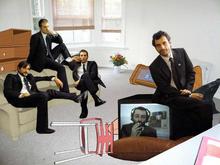
23 February 2026
Artists
The Italian Artist: A Lone Wolf, a Secret Agent, a Thorn in the Side
The solo exhibition by the Italian collective Alterazioni Video, titled "Olbania," is underway until March 8th at the National Museum of Photography Marubi in Shkodër, Albania, a significant city in the Albanian cultural scene, which is also home to Adrian Paci's Art House.
How did this collaboration with the Marubi Museum come about?
It began during a residency at the Fondazione Paul Thorel in Naples. There we met the Albanian artist Anri Sala, who put us in touch with the director of the Marubi Museum, Luçjan Bedeni, imagining the institution might be interested in "Olbania." The project had actually taken shape back in 2009, when we were invited to the 3rd Tirana Biennial, but it had never been realized. At that time, we had discovered a country that was changing its skin: for years it had watched old Italian television, because RAI signals crossed the Adriatic Sea, then suddenly it dove headfirst into the chaos of the global web. Back home, instead of boarding a ferry from Brindisi, we turned into internet tourists and explored the most hidden corners of Albania directly from our sofas. We scoured Albanian social media, stealing snippets of real life posted by amateur photographers: weddings, holidays, tuned-up Mercedes, dreams of glory, and epic failures. That's how "Olbania" was born. The title comes from a typo that became a fictitious territory, a land of Balkan mythologies and stereotypes. But "Olbania" isn't just a collection of nostalgic or dissonant stolen snapshots: it's an archive of over a thousand images capturing a historical moment of transition, a collective portrait made of mistakes and, in a sense, an accidental collaboration between us and the Albanians. Precisely because it's an "error" and it's chaotic, it's much more faithful to reality than any official or glossy narrative. It fits perfectly in the wake of our other works like "Incompiuto," consolidating our identity as experts of the "out of context." Knowing the contemporary art system allows us to bypass it, or if you prefer, to use it strategically. Its limitation is the aesthetic homologation and excessive "cleanliness" of a globalized society that makes everything flat and sterile.
Alterazioni Video started as an artistic collective in Milan in 2004. Then came collaborations with Manifesta 7, the Venice Biennale. How have international experiences shaped your artistic path?
Maybe we should start with our experiences in Italy. We've been living abroad for twenty years, and even those of us who decided to stay or return to Italy are still always on the move. The thing is, when you live abroad, you notice borders less. For us, Italy is part of the world; we move according to commissions and opportunities. Today's artist, whether we like it or not, is cosmopolitan, follows the stories they want to tell regardless of where they are, and often follows the money that produces art too. For us, Tirana or Shkodër are like New York or Paris.
Which projects have had a decisive influence on your artistic career?
No project has ever "influenced" our career; many have accompanied us like a mantra. Every time we work on a project as if it were the last, as if the world should stop and watch it, as if this time it's the one, but then nothing transformative ever happens. You have to find motivations and satisfactions elsewhere, outside the system. Sometimes, sure, you get on the elevator that takes you to the top floors and it feels like you're entering a new reality that coddles your super ego, but the elevator always comes down and brings you back. You return to the lobby, and we thrive in lobbies because there's always a bar or a sofa to refresh yourself.
Is there a possible positioning for Italian artists on the international scene?
There isn't. Italian artists are and always will be unemployed. Our positioning is in line for tickets or in boarding group 8 at the back of the plane, but in the end everyone knows that if the plane falls and breaks in two, only those at the back survive. The fact remains that the Italian artistic community is scattered and rarely wants to work as a team; it looks at other Italian artists with suspicion. They might be seen as having connections, being cunning, fleeting, but never prophets! If you think about it, it's a shame: Jews, Swiss, Americans, and even the Chinese stick together, they pass on opportunities or resources. Italians are pirates. They cheer each other on but they have to reach the top alone. They know the art of negotiation and as cosmopolitan artists, they don't feel their roots much, except when faced with pastries or a good wine. The Italian artist is a lone wolf, a secret agent, a thorn in the side. Never satisfied, never completely sold out, always ready to strike with the sharp blade of their sense of humor.
So, an answer meant to be provocative?
Sure, but it hides something structurally true and quite uncomfortable to say out loud. The Italian artist is not a system product. He's a survivor. The German, French, or American artist is exported by their own institutions as a strategic asset, a line item in the national cultural policy budget. The Italian one is left to fend for themselves, to their own private initiative, to their own courage or luck. And this creates a short-circuit that becomes almost fatal in the international market. Why should a foreign dealer bet on a name that in its own country doesn't have a network of public acquisitions behind it, no institutional support for production, no systemic validation? Italian Council exists, sure, but it's a recent, limited tool, and often perceived outside the borders as an exception, not a policy. If Italian institutions aren't the first to bet on the future of Italian art, why should a collector in Basel, or a gallerist in Miami? The foreign market reads institutional absence as a risk signal. And it's right to do so. The problem isn't talent. It never has been. The problem is that in Italy, supporting contemporary art is still politically viewed as charity, a luxury expense, almost an embarrassing indulgence. While elsewhere it's treated for what it is: a strategic investment, a soft power multiplier, a way to assert a presence in the world. Until this changes, we'll keep doing what we've been doing for decades: working excellently, being appreciated abroad, and remaining professional exiles in our own homeland.
© All rights reserved
other interviews
other interviews Carla Chiarchiaro
The poor perception of the cultural value generated by galleries is a limitation.
Artists
09 March 2026
Carla Chiarchiaro
The poor perception of the cultural value generated by galleries is a limitation.
Artists
09 March 2026
 Emilio Gola
: Painting the Story of His Generation
Collectors
30 July 2025
Emilio Gola
Emilio Gola: Painting the Story of His Generation
Collectors
30 July 2025
 Luca Bombassei
Being a Patron Today: Connecting, Listening, Acting
Curators
20 May 2025
Luca Bombassei
Being a Patron Today: Connecting, Listening, Acting
Curators
20 May 2025
 Valentino Catricalà
Invisible Talents: The Paradox of Italian Art Abroad
Valentino Catricalà
Invisible Talents: The Paradox of Italian Art Abroad