
04 July 2025 Athens Exhibition Says the Revolution Could Begin on Your Plate | 04 June 2025 Artforum, "Diana Anselmo" | 16 April 2025 Frieze, "Must-See: The Tears of Karl Lagerfeld" | 16 April 2025 Süddeutsche Zeitung Magazin, "Mit welcher Haltung kommt man in der Kunstwelt am weitesten, Maurizio Cattelan?" | 09 April 2025 The Berliner, "Consider Listening: An exhibition urging calm amidst outrage" | 02 April 2025 Wallpaper, "Aboard Gio Ponti's colourful Arlecchino train in Milan, a conversation about design with Formafantasma" | 26 March 2025 Frieze, "Diego Marcon’s Films Conjure a Familiar, Grotesque World" | 19 March 2025 Arts Hub, "1500-degree molten steel installation, inspired by Caravaggio, to drip from the ceiling of Mona" | 15 May 2024 Frieze, "Silvia Rosi Gives Voice to Her Parents’ Migration Story" | 30 March 2024 The Korea Times, "Foreigners Everywhere: Artist duo who inspired this year's Venice Biennale lands in Seoul" | 07 February 2024 Artnet News, "Ceramics Are as Contemporary as a Smartphone: Chiara Camoni on Her Tactile Sculptures"
Emilio Gola
interviews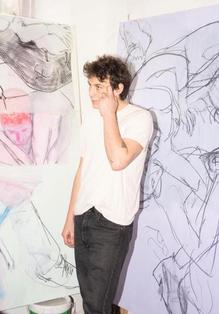
09 March 2026
Artists
Emilio Gola: Painting the Story of His Generation
Born in Milan in 1994, Emilio Gola is among the young Italian painters who, in recent years, have helped bring figurative painting back to the center of the contemporary art scene. He lives and works in Milan, the city where he also completed his training. After attending art high school, Gola began studying architecture at the Politecnico di Milano, an experience that would influence the way he constructs space within the canvas. He later decided to dedicate himself entirely to painting and continued his studies at the Accademia di Belle Arti di Brera, where he obtained a diploma in painting. This dual training—between design and artistic practice—is reflected in the structure of his works, which are often conceived as complex environments in which figures and objects are arranged according to almost architectural balances.
At the center of his research is the representation of the everyday life of his generation. His paintings feature friends, acquaintances, or peers portrayed in informal moments: conversations, waiting, rest, or scenes of domestic social life. The compositions are dense and layered: bodies, clothes, shoes, books, and objects of contemporary life accumulate within the pictorial space, creating images suspended between intimacy and unease.
Through an intense and material approach to figurative painting, Gola explores human relationships, vulnerability, and the relational dynamics of contemporary youth. In his works, the private dimension becomes a collective narrative, offering a layered and often ambiguous image of everyday life.
In recent years his work has attracted the attention of the Italian art world. After his first collaborations with Artnoble Gallery, Gola began working with Galleria Monica De Cardenas, one of the most active Italian galleries in the contemporary art scene, with spaces in Milan and Zuoz. Since the end of last year, he has also started collaborating with the Portuguese gallery Madragoa (Lisbon), run by Matteo Consonni, who recently—together with Dawid Radziszewski of Galeria Dawid Radziszewski in Warsaw—opened the Milan-based space Consonni Radziszewski, a joint project between the two galleries.
Emilio Gola’s works have been presented in solo and group exhibitions and in institutional contexts such as Triennale Milano and the 18th Quadriennale. In this interview, the artist reflects on his path, his relationship with painting, and the way personal and generational experiences shape his work.
How did your artistic journey begin?
It’s difficult for me to point to a real beginning. As a child, I used to draw in my grandfather’s studio. That’s where I first started using oil pastels with him. I always grew up surrounded by paintings at home, of all kinds. In a way, painting is a language that I’ve always considered normal.
Where and what did you study? Were there teachers or academic experiences that particularly influenced you?
I studied at the Boccioni art high school in Milan. Afterwards I earned a degree in architecture from the Politecnico di Milano, and then completed the final two years of my studies in Painting at the Brera Academy. I was fortunate to have important teachers at important moments in my life. For example, while studying architecture I still managed to keep painting: I used to go to the studio of my high school painting teacher, where she allowed me to keep some small works. The transition from amateur to professional certainly happened gradually after meeting Professor Marco Cingolani.
What were your first projects or exhibitions?
My first exhibition was Tre modi per dire la stessa cosa at ArtNoble in Milan, together with Martina Cassatella and Roberto De Pinto, curated by Antonio Grulli. Matthew Noble and Antonio Grulli believed in the exhibition project from the very beginning, showing great courage in supporting me and the other two artists—more or less all three of us at the very start of our careers.
When did your career reach a turning point?
Later, Monica De Cardenas greatly helped promote my work. She saw one of my paintings at the exhibition Pittura italiana oggi at Triennale Milano, curated by Damiano Gullì. She contacted me and we organized the exhibition Come falene in the project room of her gallery in Milan.
What advantages and opportunities did being represented by a gallery offer you?
Working with a gallery allowed me to feel more confident about my work and to better understand the economic dynamics behind the art world. It also made it possible for me to make a living through my paintings. Last year I also began collaborating with the Madragoa gallery in Lisbon, run by Matteo Consonni. With Madragoa I exhibited my work at Art Basel Miami.
How has your work changed?
Working within a gallery’s exhibition schedule certainly has its challenges. The work can be subject to different kinds of pressure. I think time becomes the most precious resource.
How did you come to exhibit or work outside Italy?
In recent months one of my works has been part of the traveling exhibition Pintura italiana hoy, una nueva escena, a project promoted by Triennale Milano in collaboration with the Italian Ministry of Foreign Affairs (MAECI), curated by Damiano Gullì, and presented in Argentina, Mexico, and Brazil. It features a specific selection of young artists born between 1990 and 2000 who participated in the exhibition Pittura italiana oggi (2023).
What have been the main obstacles in making your art known outside Italy?
It seems to me that the real difficulty in bringing work abroad lies in actually entering into contact with the local context, rather than simply exhibiting outside Italy. I don’t think it’s mainly a matter of promotion or communication, but of managing to integrate into an existing cultural environment that can speak to its own audience. It’s a question of cultural context.
Do you think social media are an indispensable or a limiting tool for artists today?
When it comes to social media, I might be the wrong person to ask, because I’ve always given them little importance. It’s a small bubble: people believe their work becomes visible to everyone, but I don’t think it really has that reach. Even in that case, the work may be seen for its aesthetic value, but in order to truly exist it needs to belong to a context.
Have you participated in open calls, residencies, or art prizes?
I haven’t participated in open calls or residencies so far, but I took part in the Fondazione Francesco Fabbri Prize in 2023 and in the 2024 edition of the Cairo Prize. I have very fond memories of both experiences.
Do you have any advice for young artists who want to apply?
I don’t have many suggestions for young artists who want to take part in these competitions, except perhaps to try to understand the reasoning behind a jury’s selection.
You were among the participants in the 18th Quadriennale. Can you tell us how your selection by Luca Massimo Barbero came about?
My selection for the Quadriennale in Rome actually began with the Cairo Prize, where Luca Massimo Barbero was one of the jury members. From that moment a dialogue started that eventually led to the invitation to the Quadriennale. For his section—titled “My image is what I allow to represent me: the self-portrait. Food, cats, the gym, myself, travels and various trinkets”—I painted the people I feel most intimately connected to: my brothers. In some way I tried to portray them in relation to my studio—the place where I live, where everything represents me.
How do you see your career developing in the coming years?
I don’t think about my career in terms of “positioning.” Rather, I try to make choices that allow me to go deeper and deeper into my work, and to further develop my understanding of painting. Only in this way, as a consequence, will interesting opportunities arise.
© All rights reserved
artists
other interviews
other interviews Alterazioni Video
The Italian Artist: A Lone Wolf, a Secret Agent, a Thorn in the Side
Collectors
30 July 2025
Alterazioni Video
The Italian Artist: A Lone Wolf, a Secret Agent, a Thorn in the Side
Collectors
30 July 2025
 Luca Bombassei
Being a Patron Today: Connecting, Listening, Acting
Curators
20 May 2025
Luca Bombassei
Being a Patron Today: Connecting, Listening, Acting
Curators
20 May 2025
 Valentino Catricalà
Invisible Talents: The Paradox of Italian Art Abroad
Curators
20 May 2025
Valentino Catricalà
Invisible Talents: The Paradox of Italian Art Abroad
Curators
20 May 2025
 Vittoria Matarrese
Italian Art, a Global Vocation in a Local System
Vittoria Matarrese
Italian Art, a Global Vocation in a Local System